



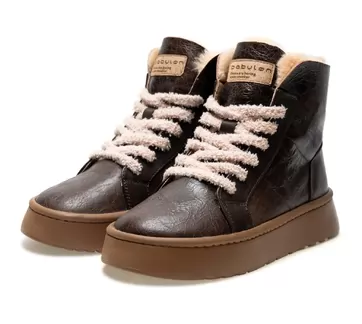
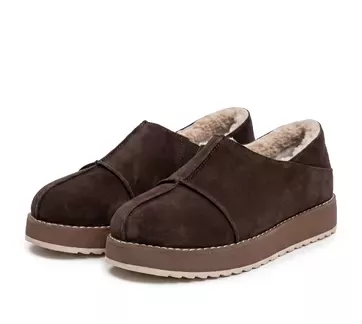
EU, US and UK shoe sizes: conversion chart and how to measure your foot
A conversion chart gets you to the right neighbourhood; your foot length in centimetres gets you to the right door. Here are the women's and men's EU–UK–US charts, why they are only a guide, and how to check a size against the chart of the exact model.

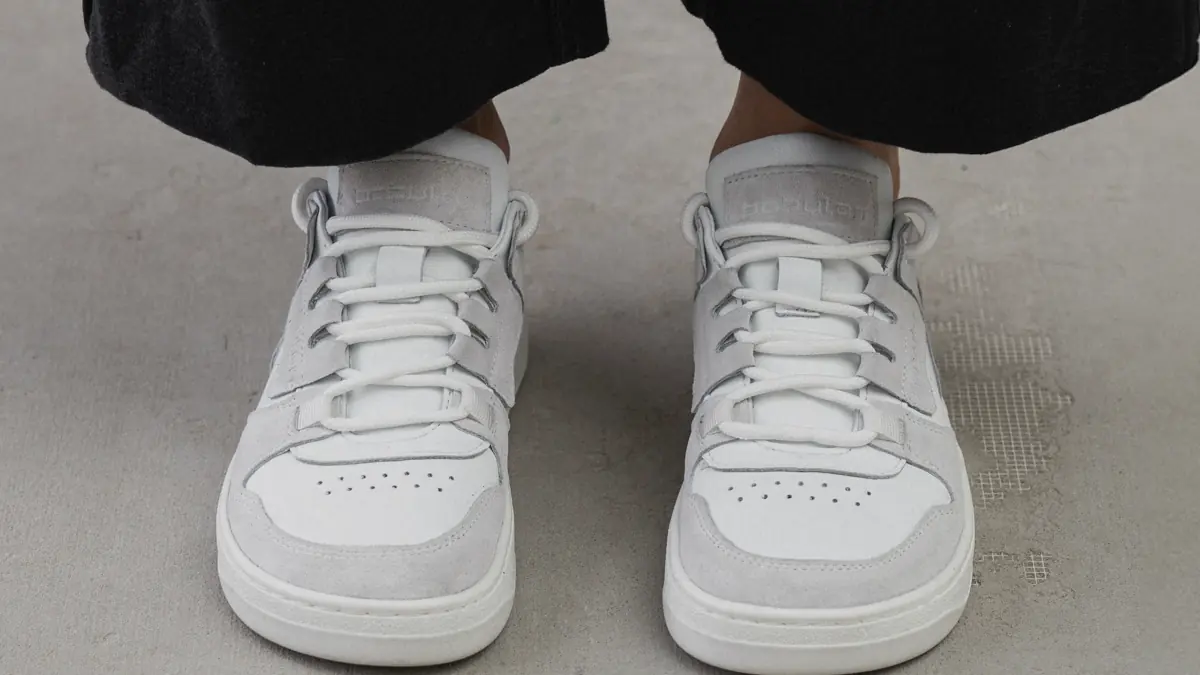
In short
EU, UK and US shoe sizes use different units, so conversion charts are approximate: a women's EU 38 is usually a UK 5 and a US 7.5, a men's EU 42 a UK 8 and a US 9. Brands round differently, so use the chart to narrow it down, then compare your foot length in cm with the model's own table. Babylon makes shoes in whole EU sizes and publishes a foot-length table on every product page.
How do EU, UK and US shoe sizes compare?
They measure the same foot in different units, so they never line up exactly. A women's EU 38 is usually a UK 5 and a US 7.5; a men's EU 42 is usually a UK 8 and a US 9. Use a conversion chart to find your likely size, then confirm it with your foot length in centimetres.
The three systems were built on different steps:
- EU (Paris point). One size equals 2/3 cm, about 6.7 mm. Men's and women's numbers are on one scale.
- UK (barleycorn). One size equals 1/3 inch, about 8.5 mm, with half sizes in between. Men and women share the scale too.
- US. The same 1/3-inch step as the UK, but the numbers start from a different point, and women's sizes are counted separately from men's.
Because 6.7 mm and 8.5 mm do not divide into each other, every conversion involves rounding. That is why two brands can label the same EU 39 as a UK 5.5 and a UK 6.
Women's shoe size conversion: EU to UK and US
For women, add roughly 2.5 to the UK size to get the US size, and expect EU 36–41 to cover UK 3.5–7.5. Treat the chart below as a starting point, not a promise.
| EU | UK | US women's | Foot length on the Space-90 page, cm |
|---|---|---|---|
| 36 | 3.5 | 6 | 23.2 |
| 37 | 4 | 6.5 | 24.0 |
| 38 | 5 | 7.5 | 24.6 |
| 39 | 6 | 8.5 | 25.2 |
| 40 | 6.5 | 9 | 26.0 |
| 41 | 7.5 | 10 | 27.0 |
The last column is quoted from the size table of the women's Space-90 sneakers. Another model can list a slightly different length for the same EU size, which is the whole point of the next sections.
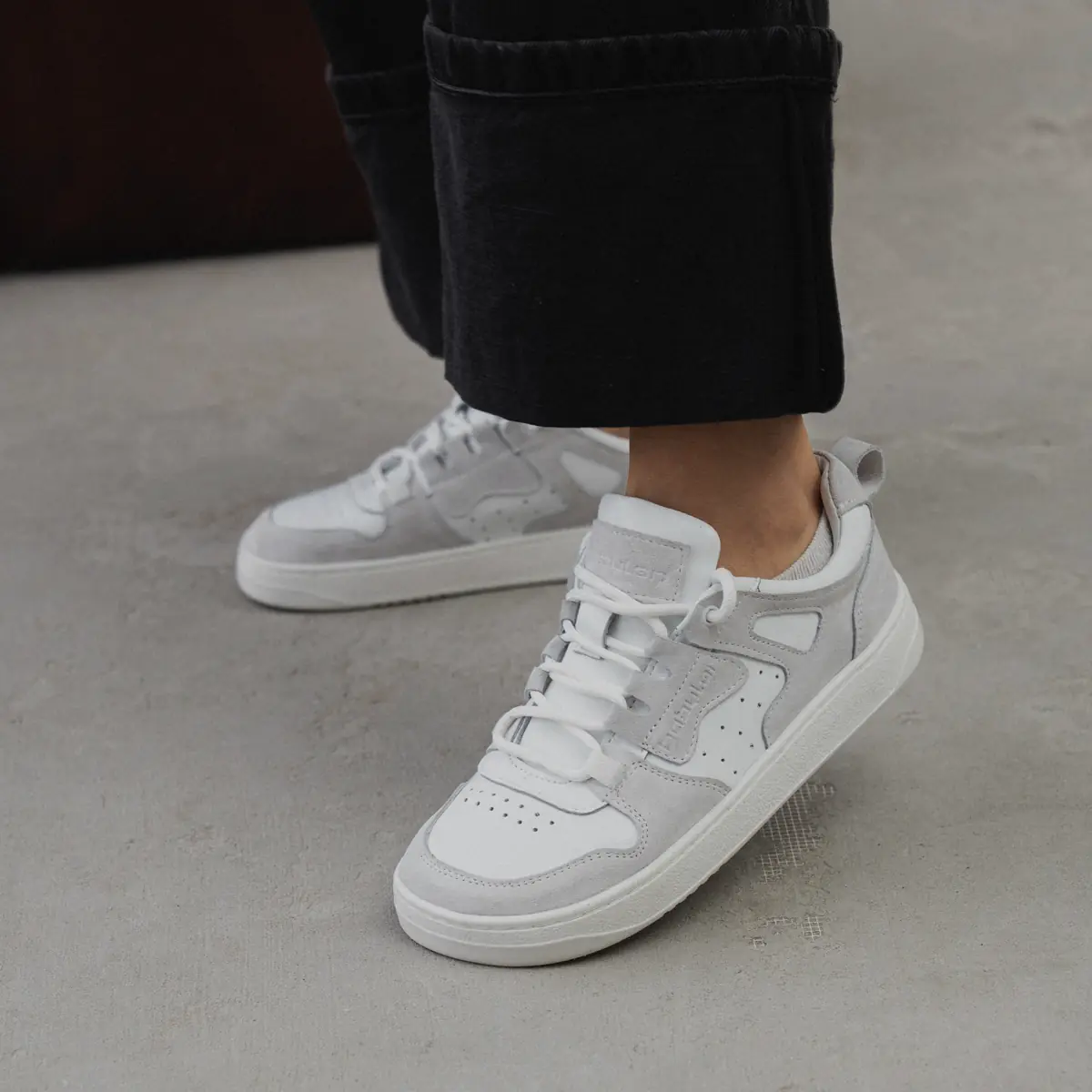
Men's shoe size conversion: EU to UK and US
For men, the US size is usually one size above the UK size, and EU 39–45 roughly covers UK 6–10.5. Again, this is the common conversion, not a law.
| EU | UK | US men's | Foot length on the Frost-84 page, cm |
|---|---|---|---|
| 39 | 6 | 7 | 25.5 |
| 40 | 6.5 | 7.5 | 26.1 |
| 41 | 7.5 | 8.5 | 26.8 |
| 42 | 8 | 9 | 27.5 |
| 43 | 9 | 10 | 28.3 |
| 44 | 9.5 | 10.5 | 29.0 |
| 45 | 10.5 | 11.5 | 29.5 |
The foot lengths are quoted from the table of the men's Frost-84 sheepskin boots. Babylon's men's range usually runs EU 39–45. For larger sizes, ask our manager before ordering; we do not promise them.
Why do conversion charts differ between brands?
Because a size is a property of the last — the form a shoe is built on — not of your foot. Each brand decides how long its last is for a given number and how to round between systems. The chart tells you which size to look at; the model's table tells you whether it fits.
Three things move the result:
- The last. Babylon makes almost every model on its own last, so even within one brand the same EU number can match a different foot length. Our size guide shows this: the Montana and Michigan sneakers are made on a different last, where the same size fits a longer foot.
- Rounding. EU steps are 6.7 mm, UK and US steps 8.5 mm. Somewhere in every chart a brand has to choose whether 39 becomes UK 5.5 or 6.
- The lining. Fur, sheepskin and thick padding take up space inside. A boot and a sneaker labelled with the same number can feel different.
There is an international standard for converting between systems, ISO 19407, and a system that uses foot length directly: Mondopoint, where a shoe is labelled with the foot length in millimetres. Few fashion brands print Mondopoint on the box, but it explains the logic. Your foot length is the one number that does not need converting.
How do I measure my foot length?
Stand on a sheet of paper against a wall in the evening, mark the tip of your longest toe with a pencil held upright, and measure from the wall to the mark. Do both feet and use the larger figure, rounded to 0.5 cm.
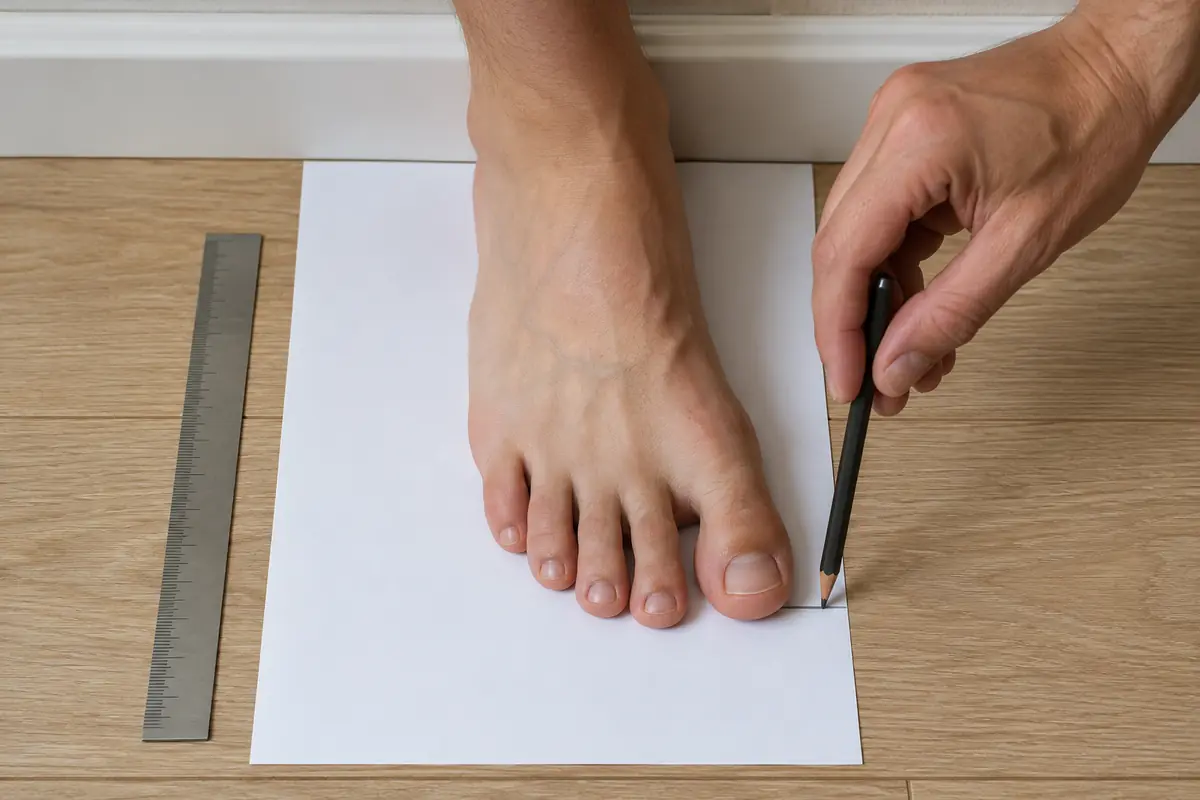
The short version:
- Evening. Feet get slightly larger during the day.
- Standing. Your weight spreads the foot as it does in a shoe.
- Pencil upright. Tilting it under the toes makes the result too short.
- In the right socks. For winter shoes, measure in the socks you will wear with them.
The step-by-step method, with pictures and common mistakes, is in “How to measure your foot at home”. Do not add anything to your measurement: on Babylon's tables the fitting allowance is already built into the last. UK NHS footwear advice puts that room at about 1 cm in front of the longest toe.
How do I use the size table on a product page?
Find your foot length in the model's table and choose the smallest size whose value is not less than your measurement. If you fall between two values, take the larger size or message our manager, who will check that pair's table for you.
Example with real numbers. Your foot is 24.3 cm. On the Space-90 table, EU 37 lists 24.0 cm and EU 38 lists 24.6 cm, so the answer is EU 38. On a standard chart that is a UK 5 or US 7.5, but you did not need the chart to decide.
Every Babylon product page also has a “Find my size” button under the size selector. You can enter the size you wear in Nike, adidas, Converse or another brand, or your foot length in centimetres, and it compares that with the model's table.
 LeatherWomen's sneakers in combination leather Space-90Lining: Respira — Italian lining leather; sole: flexible€95View
 LeatherMen's sheepskin boots, down to −20 °C Frost-84Heel counter and decorative tongue insert: genuine leather; inside: dense; insole: fur-covered€115View
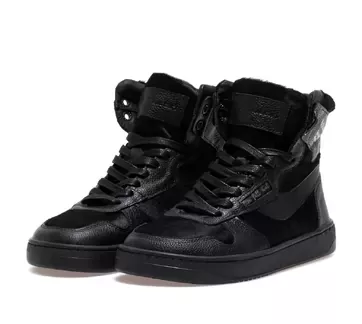
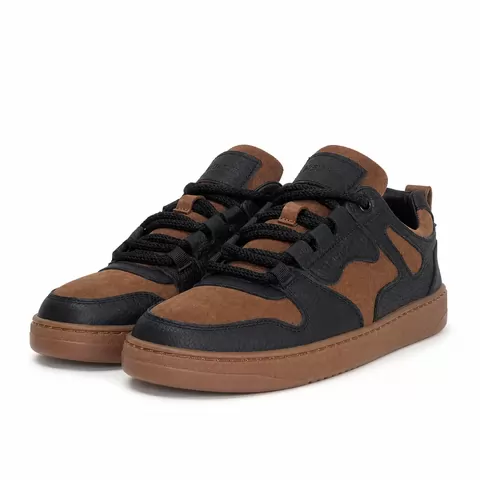 LeatherMen's sneakers in combination leather Space-44Lining: Respira — Italian lining leather; sole: TPE (thermoplastic elastomer); fit: suitable for wide feet€95View
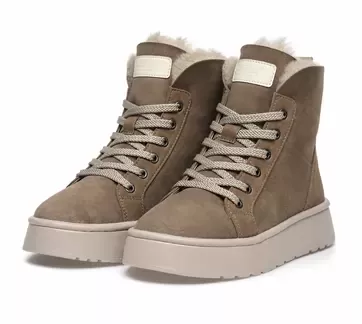
 LeatherWomen's sheepskin boots, down to −20 °C UG-1-41Inside: thick; sole: lightweight; temperature: down to −20 °C€133View
Why are there no half sizes in EU sizing at Babylon?
Because the EU step is already small. One EU size is 6.7 mm, finer than a full UK or US step of 8.5 mm, so a whole-size EU grid comes close to what UK and US sizing does with halves. Babylon's tables list whole sizes only.
If you wear a UK 5.5 or a US 8, that is not a problem. Convert it to centimetres via your own foot, not via the label: measure, then pick from the model's table. If the measurement sits right on the edge, the lacing helps. A laced pair can be tightened a little; a pair that is too short cannot be fixed.
What about socks and winter shoes?
Measure in the socks you plan to wear and do not size up by reflex. Fur and sheepskin linings are allowed for in the last, and a boot that is too big lets your heel slip and warm air escape.
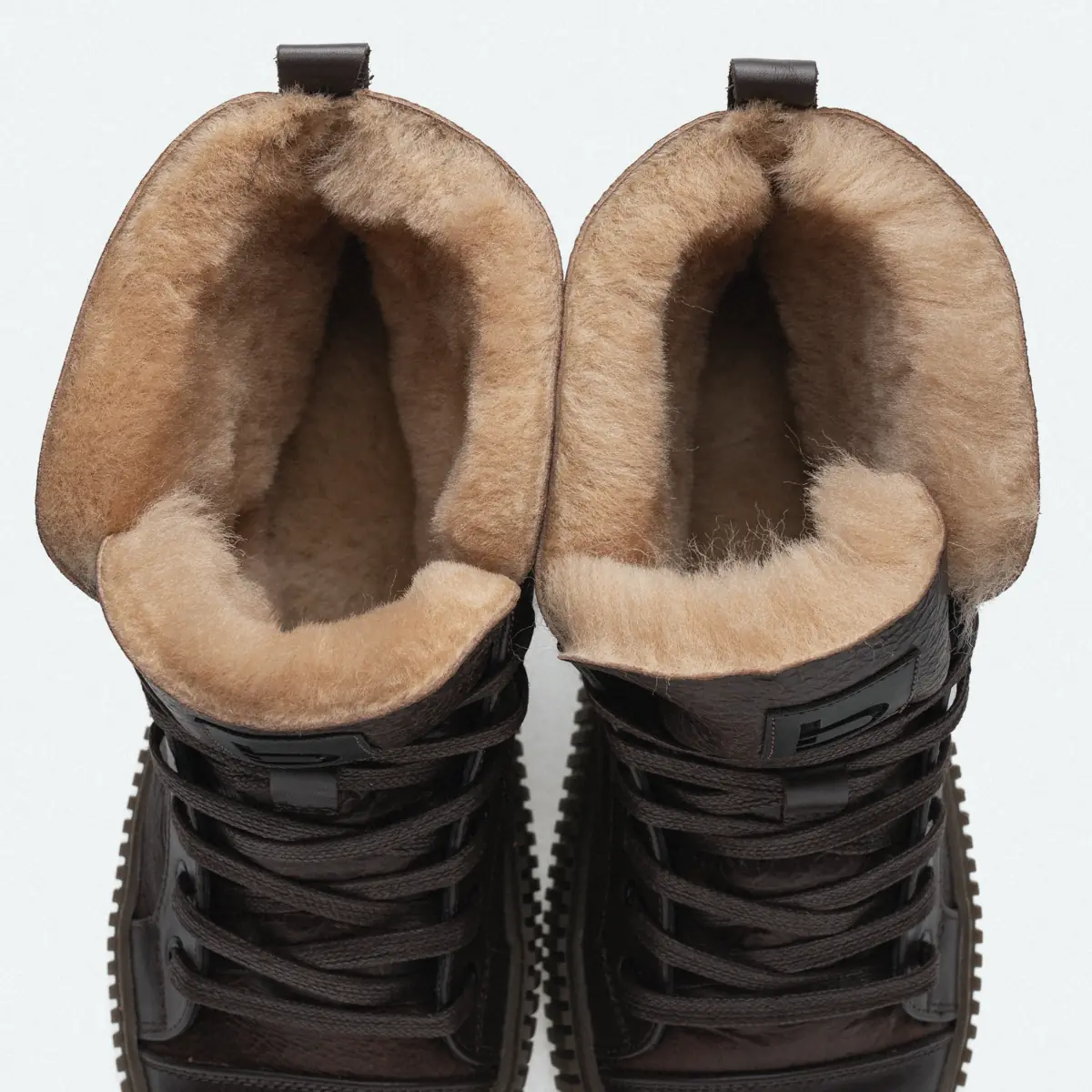
For sheepskin boots there is one more effect: the dense fleece is springy at first and packs down slightly with wear. A new pair should feel snug, not loose. We cover this in detail in “Sheepskin boot sizing”, and the wider choice of winter pairs in “How to choose winter shoes”.
What if I have wide feet or a high instep?
Length is only half the fit. Trace your foot, measure the widest part across the toes, and send that number with your foot length. For a high instep, choose a laced model: the lacing over the instep can be loosened without changing the size.
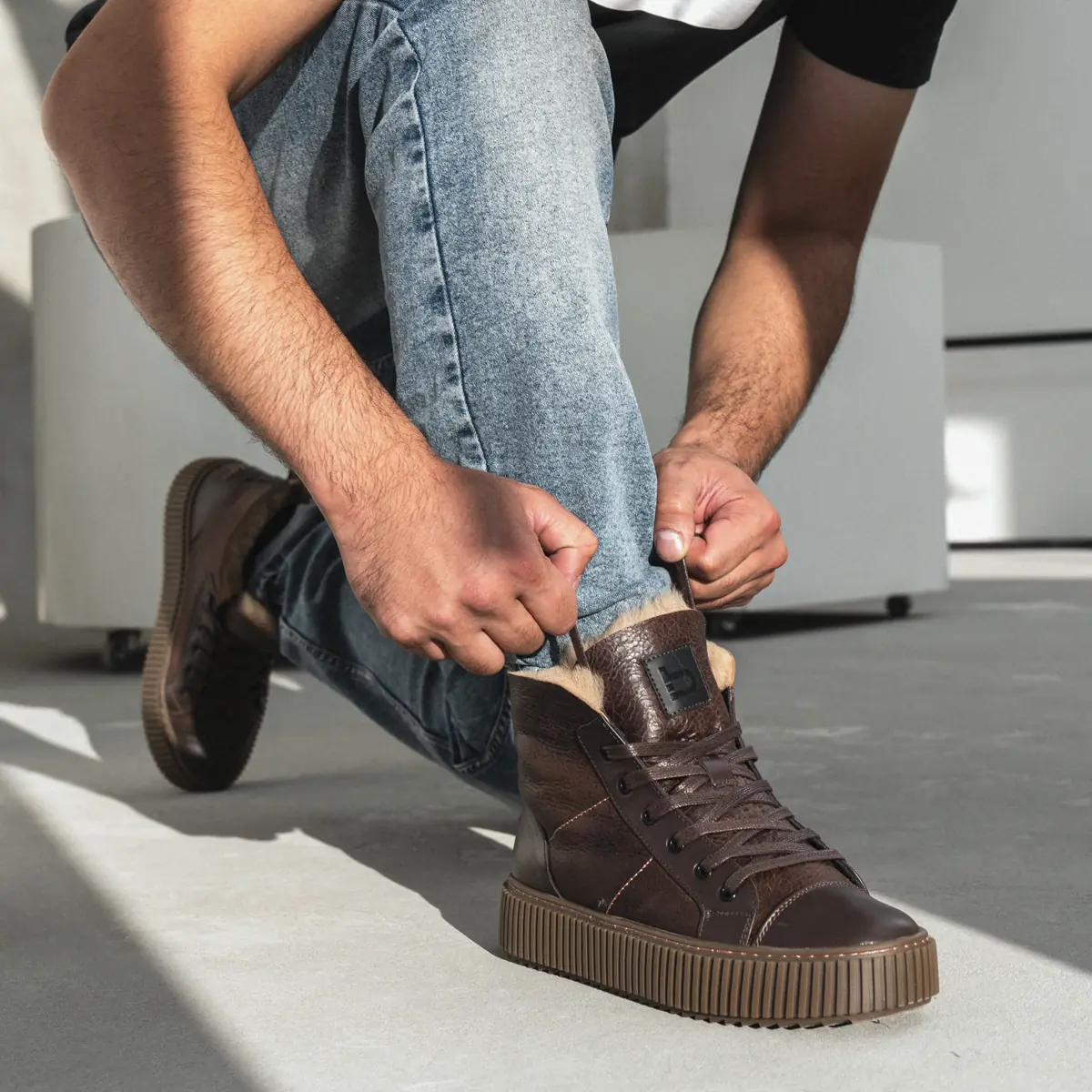
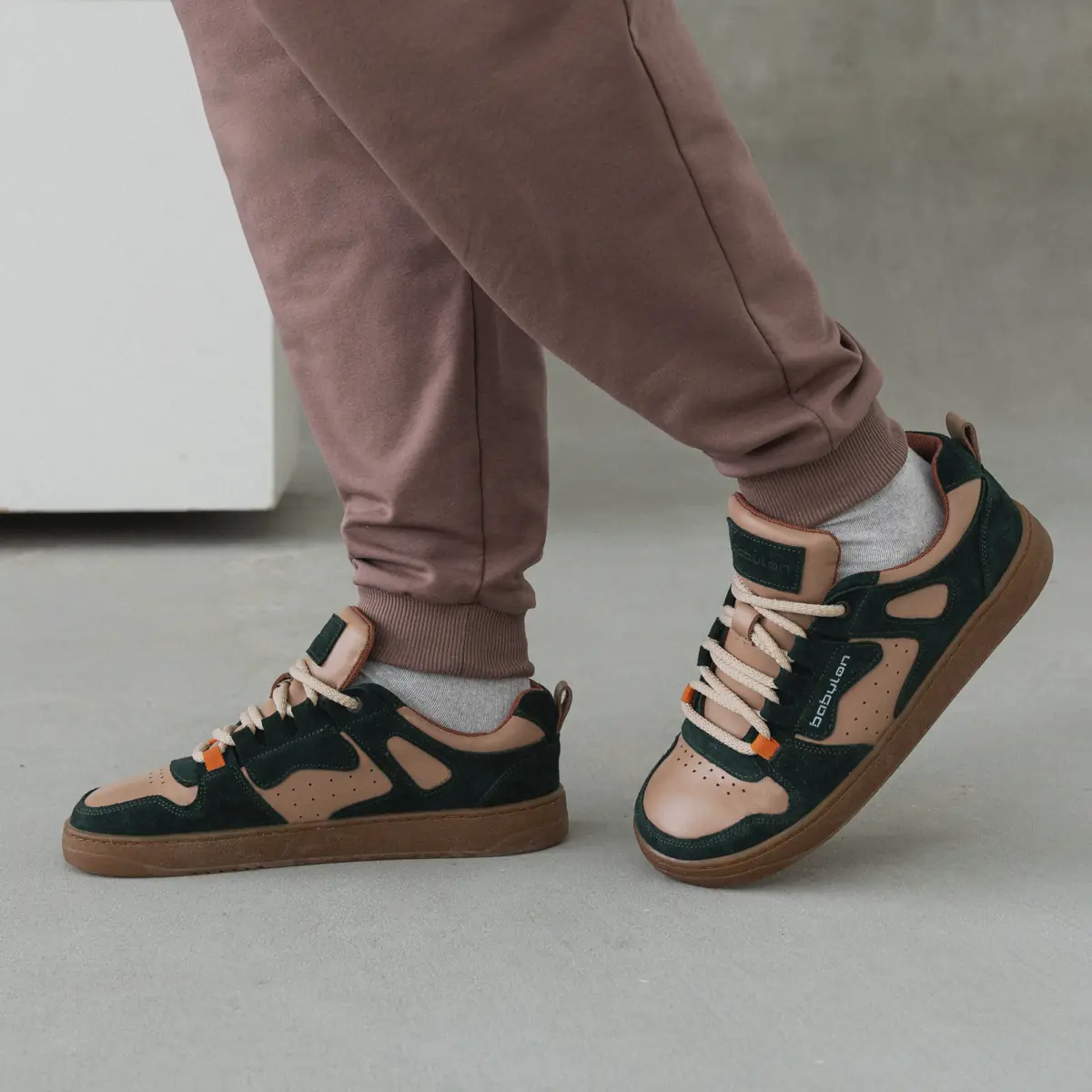
Some product pages state the fit directly. The compositions of the men's Space-44 and Space-14 sneakers list “Fit: suitable for wide feet”, and the Space-90 page describes a relaxed fit that works even for wide feet. If no model suits you, a catalogue model can be adapted to foot width or instep height — ask our manager.
What happens if the size is wrong?
International orders can be returned or exchanged within 30 days of delivery, if the pair is unworn and in its original condition and packaging. For a size exchange, return postage is paid by the customer; we refund the product price.
Before you order:
- Check the table of that exact model, not a general chart.
- Send the manager your foot length if you are between two values.
- Try the pair on indoors on a clean floor, so it stays returnable.
Shipping to you is included in the € price and takes 5–10 business days to the EU, the UK, Switzerland, Norway, Liechtenstein and Moldova, and 7–12 to the US, Canada, Israel, New Zealand, Georgia and Montenegro. In-stock sizes ship today or tomorrow; made-to-order sizes take up to 3 business days to make. Full terms are on the Returns & Exchanges Policy page.
Browse women's sneakers, men's sneakers and winter footwear — every product page has its own table.
FAQ
What is a women's EU 38 in US and UK sizes?
On the standard conversion most retailers use, a women's EU 38 is a UK 5 and a US 7.5. Some brands label the same shoe as a US 7 or 8, because each brand rounds the half sizes its own way. If you are between two US sizes, check your foot length in centimetres against the model's own table before ordering.
Is a men's US size the same as a women's US size?
No. In the United States women's sizes run higher than men's for the same foot: depending on the scale, by one or one and a half sizes. So a man who wears a US 9 and a woman who wears a US 10 or 10.5 may need the same length. UK sizes do not split this way, and EU sizes never do.
Do EU sizes come in halves?
Some brands label EU half sizes, many do not. One EU step is two-thirds of a centimetre, which is already finer than a full UK or US step of a third of an inch. Babylon's product tables list whole sizes only; if your foot falls between two values, ask the manager to check that model's table.
Should I order a size up for winter boots?
Not automatically. Measure your foot in the socks you will wear with the boots and compare that length with the model's table: fur and wool linings are already allowed for in the last. A pair that is too big lets the heel slip and lets warm air escape. For fur-lined models, ask the manager if unsure.
My foot is 26 cm. What size is that?
It depends on the model. On the Babylon Space-90 table, 26.0 cm is listed under EU 40; on the Frost-84 men's table, the nearest value that is not shorter is 26.1 cm, also EU 40. On a standard chart EU 40 is about a women's US 9 or a men's US 7.5, but the model's own table is what decides the size.
What if the shoes don't fit after delivery?
International orders can be returned or exchanged within 30 days of delivery if the pair is unworn and in its original condition and packaging. Email the returns address first; return postage for a size exchange is paid by the customer. Shipping to you is already included in the price.
Works at Babylon's family-owned factory in Kharkiv, Ukraine. The factory employs 25 craftspeople and 2 technologists; leather and fur come from Spain and Turkey, soles are made to order, and every pair is made by hand. All articles by this author
Sources and notes
 Size & fit
How to choose your sheepskin boot size: how much room and how to measure
Sheepskin boots are chosen by foot length and the size chart of the specific model, not by your sneaker size. Here is why the fleece inside changes the fit, how much toe room to leave and what to do if you fall between two sizes.
 Size & fit
How to measure your foot at home and choose your shoe size online
When you buy shoes online, choose by foot length in centimetres, not by the number you are used to. Here is how to measure your foot correctly, how centimetres relate to EU sizes, and how to use the size table on each Babylon product page.
 Materials & care
How to store shoes between seasons: summer pairs for winter, winter boots for summer
In October, summer sneakers, sandals and loafers go into storage and winter boots come back out. Here is how to prepare a pair for a few months in a box so it comes out in spring looking the way it did in autumn.